
Tent hire Cape Town › Stretch Tent Hire
Stretch Tent Hire
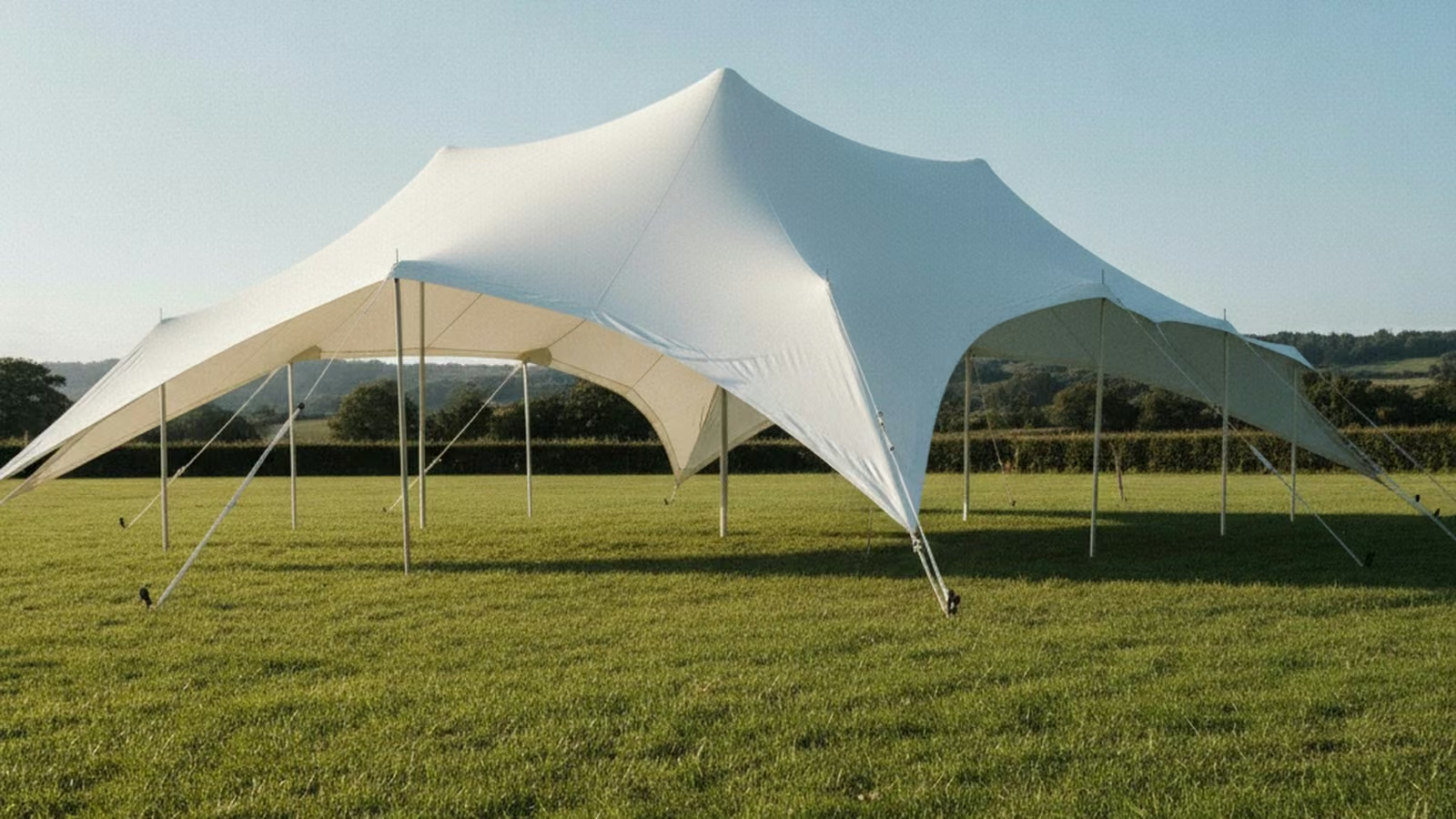
A single sheet of tensioned fabric held on poles and guy lines, with no interior poles and no rigid frame, so your floor plan stays completely open. It can be pitched to follow an awkward site instead of fighting it, and it sheds the Cape south-easter better than a flat-roofed structure does. Sizes from 6x9m to 12x15m.
Why stretch tents took over Cape events
A stretch tent is a single piece of engineered fabric pulled taut between poles and guy lines. There are no interior poles and no rigid frame, which is the whole point: your floor plan is completely open, and the shape can be pitched to follow an awkward site instead of fighting it.
They also suit the Cape specifically. The fabric sheds the south-easter better than a flat-roofed structure, and a stretch tent can be pitched low on an exposed site or high and open on a still evening.
Where a stretch tent is the right call
- Lawns and gardens — anywhere pegs can go into ground
- Wine estates and farms — it looks like it belongs, which a white box does not
- Irregular sites — around a tree, over a pool, down a slope
- Open-sided events — where you want the view, not walls
Where it is the wrong call
Being straight about this saves everyone a wasted site visit. A stretch tent is not the right structure if you need to fully enclose the space in winter, if the site is solid paving with no anchor points and no room for ballast, or if you want a formal lined interior. In those cases a marquee or frame tent is better.
Sizes and coverage
| Size | Floor area | Standing / cocktail | Seated at tables |
|---|---|---|---|
| 6m × 9m | 54 m² | ~50 | ~30 |
| 10m × 12m | 120 m² | ~100 | ~70 |
| 12m × 15m | 180 m² | ~150 | ~100 |
Multiple stretch tents can be joined for larger events. Rates by size are on tent hire prices, and for a formal or winter event compare a marquee instead.
Stretch tent hire prices
A stretch tent in Cape Town typically runs R1,500 for a 6×9m up to R6,500 for a 12×15m, delivered, pitched and struck.
| Size | Capacity | Rate includes | Typical market rate |
|---|---|---|---|
| 6m × 9m | 50 guests standing / 30 seated | Delivery, pitching, anchoring, strike | R1,500 – R2,500 |
| 10m × 12m | 100 guests standing / 70 seated | Delivery, pitching, anchoring, strike | R3,000 – R4,500 |
| 12m × 15m | 150 guests standing / 100 seated | Delivery, pitching, anchoring, strike | R5,000 – R6,500 |
Every rate above covers delivery, pitching, anchoring and the strike afterwards anywhere inside the 60km working radius. Ballast weights for a paved site are included; lighting and flooring are quoted separately.
Read this first. These are typical Cape Town market rates, gathered from competitors’ published price lists so you can budget before you enquire. They are not a quote and not necessarily our rates. Send us your date and headcount for a firm, itemised figure — or see the full breakdown on tent hire prices.
Bedouin tents are the same structure
Bedouin tent hire and stretch tent rental describe what we pitch here. The names come from the shape rather than the product — a bedouin is a stretch tent pitched with high centre peaks and long sweeping sides, which is the look most Cape venues ask for. A bedouin quoted to you elsewhere is the structure on this page, at the rates above.
Stretch tent questions
Do you hire stretch tents near me?
Yes, anywhere inside a 60km working radius of the city — the metro, the Winelands and the Helderberg. Coverage in full on where we deliver.
Is a bedouin tent the same as a stretch tent?
Yes. Bedouin describes the pitch, not a different product. Both names refer to the same tensioned-fabric structure with no interior poles.
Are stretch tents waterproof?
Yes. The fabric is fully waterproof and pitched with a deliberate fall so water runs off rather than pooling. Rain is not the problem; wind is.
Can a stretch tent go on paving?
Yes, using ballast weights instead of pegs. Tell us the surface when you enquire because it changes the crew and the kit we bring.
Can you join two stretch tents?
Yes — that is the usual way to cover a large or awkwardly shaped event rather than using one enormous structure.